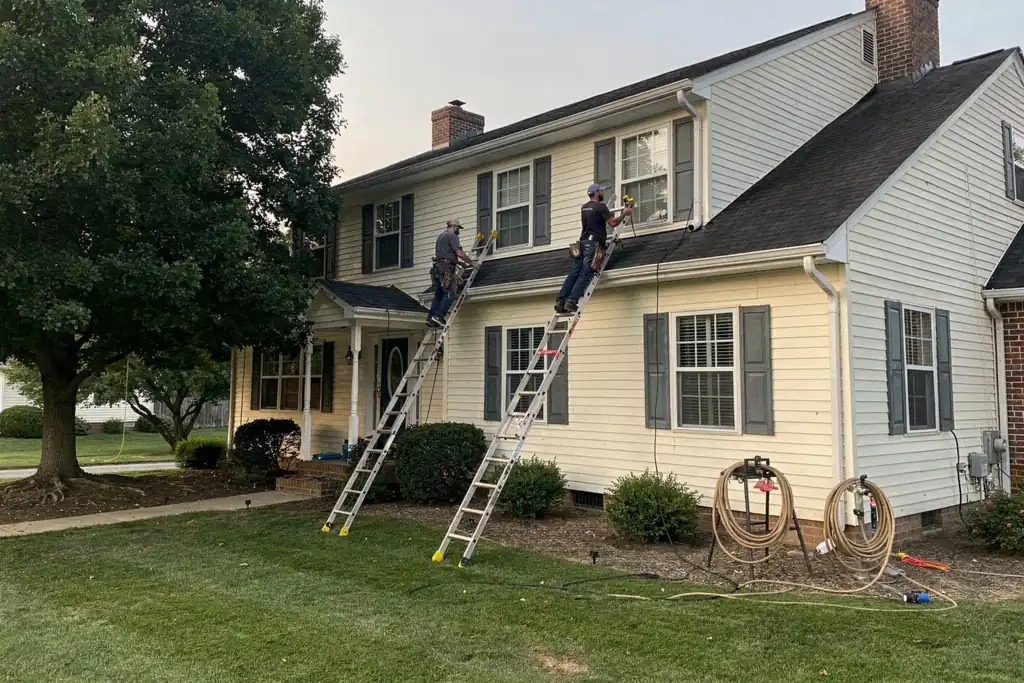
Commercial gutters and downspouts get cleaned on a per-building quote, in writing, before any crew is dispatched. Commercial gutters run longer and sit higher than most house gutters, and the leaf load in fall can fill a run faster than owners expect. Storm debris can do the same after a hurricane or tropical storm. Every building gets the equipment its height needs. Send the building details for a quote, or a list of sites if you manage several buildings.
We quote commercial gutter cleaning per building, from the linear footage, the building height and the gutter type, and the quote is in writing before dispatch. Height is the biggest single factor, so a multi-story building costs more to clean than a single-story one with the same footage. Extra work adds time: compacted debris, guards that have to come off and go back on, box gutters, and roof drains or scuppers on flat roofs. The number of buildings on the site counts too. For a figure on your building, call (866) 435-6328 or send the building details and we will put a written quote back to you.
Fall timing depends on where the building sits, and we confirm the window when you send the address. For most of the state the fall visit falls November to early December. In parts of the state it runs late October to November, and in other parts late November to December. The aim is to get the crew in after the leaves drop and before the hard freezes, when the wet leaf mat is heaviest in the runs. The spring visit runs late April to May and clears the pollen and seed that packed the downspout elbows over the winter. Rainfall here runs about 38 to 65 inches a year and snowfall about 3 to 26 inches, so a run that holds wet debris can hold water and ice through the cold months. On the coast, hurricanes and tropical storms can leave debris in the runs, and the crew checks the runs and drains that took the worst of it after the storm. For a schedule that fits your buildings, call (866) 435-6328 or send the building list.
We quote per building. The quote comes from the linear footage, the building height, the gutter type and any extra work such as roof drains or guards, and it is put in writing before we dispatch. Linear footage is one way to size the job, but the figure in the written quote is the one you pay.
The building address, the number of stories and the approximate linear footage of gutter and downspout. Tell us about any roof drains, scuppers or guards you know of. The quote comes back in writing before we dispatch a crew.
Flat roofs need extra attention because their drains can back up without any warning from the ground. The visit frequency for your building is set when we quote it, based on the roof and the trees around it.
Yes. Send the list of buildings and we quote each one on its own line in a single written document, so an owner or board can check the figures for every site. The schedule is set across the whole portfolio.
Yes. We schedule around the hours and access rules the property manager sets. Before the first visit, confirm the parking for the lift and any areas the crew must keep out of, and we will plan the day around those.
Once the storm has passed and it is safe to get a lift on the site. Hurricanes and tropical storms on the coast push leaves, limbs and debris into the runs, and a clogged run can pull water behind the fascia without anyone seeing it from the ground. Call us and we will check the runs and drains that took the worst of it.
Call (866) 435-6328 or text a photo of the house front. The number we give is the number on the invoice.
We also serve these communities across the state