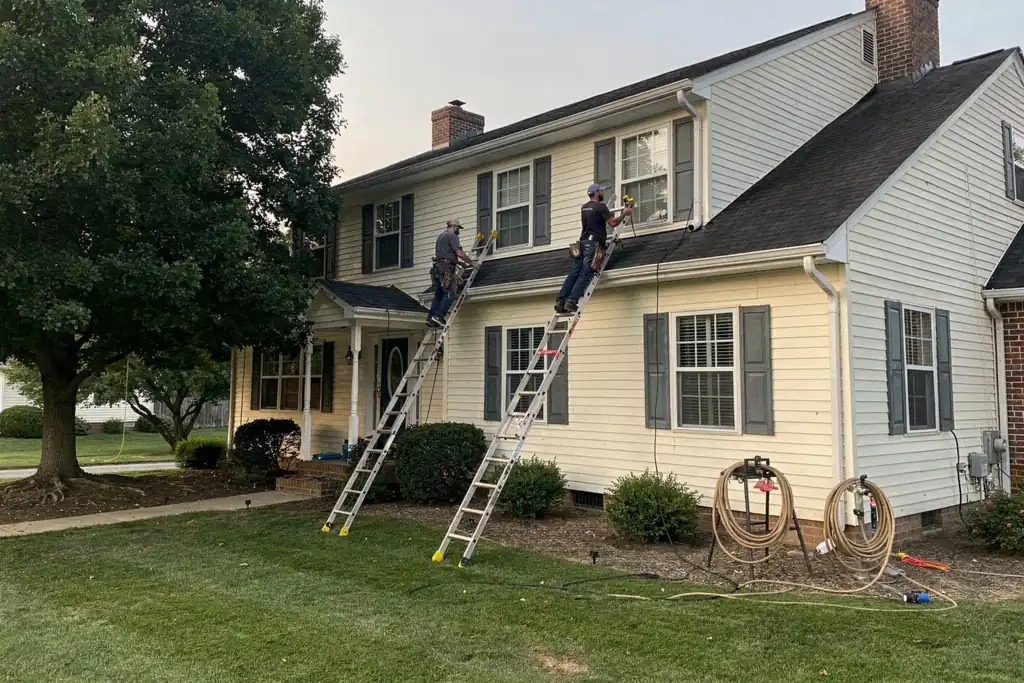
Our own crew gives your gutters a clean finish in Brandon, flushing every downspout, flow-testing each run and hauling it all away. Photos of every run arrive on your phone before we leave. The price comes from stories, size and tree cover, and the number we give on the phone is the number on the invoice. Most of our customers book in spring and fall, and you can call (866) 435-6328 to get your slot.
Quoted from stories, size and tree cover, over the phone, with nothing added once the crew is on the roof.
The price depends on stories, square footage and what is in the gutters. We quote it over the phone or by text from those three things, and the number we quote is the number we charge. Companies that price gutter maintenance by linear foot land in a similar place per foot, but on a house with a steep roof or a third story the length alone does not tell the story. Homeowners here get the same gutter cleaning process, and the number is set before the crew climbs a ladder.
On our jobs the things that move a quote are a third story or a roof too steep to walk, a walk-out basement or sloped lot that lifts the eave line, gutters nobody has opened in years and packed solid with twig and leaf debris, sometimes with a slow leak already showing at a seam, and gutter guards we have to lift and reseat. Downspout flushing, drainage checks and haul-off of everything away from your home are included and never billed as extras, and the cleaning and maintenance is part of the same number. A trough that is already partly clean when we arrive is quicker to finish, and a single clog at the elbow adds time to any run. Anything that changes the job is raised with you before work starts, never on the invoice.
Brandon homes show this clearly. On one job the house had two stories and heavy leaf load on a shaded side, and the quote reflected what the crew found in the troughs once the first run was opened. The customer heard the number before we climbed the ladder. Share the house front by text when you call, and we will tell you what your home needs to get your gutters clean and what it will cost to keep them clear. Brandon averages about 62.6 inches of rain a year, and heavy rainfall peaks in June, July and August, so a neglected system gets harder to clear by then. The sooner we look, the simpler the number.
| One story | Two stories | Three stories or steep | |
|---|---|---|---|
| Under 1,500 sq ft | from $150 | from $195 | from $255 |
| 1,500 to 2,500 sq ft | from $170 | from $225 | from $295 |
| Over 2,500 sq ft | from $200 | from $265 | from $345 |
For context, nationally: Angi 2026, US average $168, most $119 to $234, $0.95 to $2.25 per linear foot.
Downspouts flushed and flow-tested, debris hauled, photos of every run. The quote already has all of it in.
Our crew clears every gutter run by hand, not just the stretch you can see from the driveway. Roof valleys and the area above the gutter line are blown clear first, so the next rain does not refill what was just emptied. Every downspout is flushed with water and watched until it runs clear at the bottom; one that will not clear is worked from the top where it can be reached. Where a downspout feeds an underground drain line, the crew checks that water is leaving at the outlet and tells you if it is not; clearing a buried line is a separate job and is quoted before anyone touches it.
Debris goes into bags and leaves with the truck. It is not blown onto the lawn, the deck or next door. The ground is left as it was found.
Before the crew leaves you get photos of every run and every downspout, before and after, on your phone, whether or not you were home. Anything the crew sees that is not a cleaning problem, a hanger pulled loose, a seam dripping, a run sitting flat, is photographed and reported, not repaired and not sold on the spot.
What can change the number, and you hear it before work starts, never on the invoice: a third story or a roof too steep to walk; gutters that have not been touched in years; guards that have to come off and go back on.
Twice a year for most houses: once after the spring seed and pollen drop, once after the last leaves fall.
Most of our customers book twice a year, in spring after the seed and pollen drop, and again in November or December after the leaves come down. Across Florida the spring window is mid to late April, and fall runs November to December. In spring we find a buildup of seeds, seed casings and pollen paste packed into the downspout elbows, which is how a clog starts. In fall it is the wet leaf mat, and on houses that skipped the fall visit we have seen runs sag or pull away from the roofline by the next rainy season, which is when a full gutter starts to cause structural damage and wood rot. The wettest months, June, July and August, add their own load of leaves and debris to gutters that were already full, and the pattern holds across Florida.
Under heavy tree cover, every three to four months is the schedule we see work, because needles and grit pack the downspout between visits. Left alone, clogged downspouts back rainwater up under the shingles, so regular gutter cleaning matters more under big trees than anywhere else. Few or no trees, once a year in late fall is enough, and a rain gutter on an open lot rarely needs more. Homes near a busy road or active construction tend to need the shorter schedule too, and commercial properties under big trees follow the same rule. Keep the gutters clean between visits and the water away from the foundation, and the schedule stays easy to keep.
Our crew has worked on every kind of gutter system across Brandon for years, and every gutter cleaning service we book starts with the same question: what does this landscape drop onto the house? After the first visit we tell you how often you should clean your gutters, which schedule your lot actually needs, and the photos show you the reason.
Water over the edge rots the board behind the gutter first. Everything after that is slow, and slow is what a policy excludes.
The three signs. Water pouring over the front edge in rain instead of out of the downspout. A run that sags, sits low or has pulled away from the fascia. Plants growing out of the trough. Any one of them means the gutter is full.
What happens next. Water that cannot drain sits in the trough and spills behind it. The fascia board rots, then the soffit. Water backs up under the first course of shingles and shows up as a ceiling stain. Siding stains and swells. Below, the overflow cuts a channel at the foundation and finds the basement. The wet debris itself weighs enough to pull the gutter off the house. Standing water breeds mosquitoes; dry debris houses wasps. Where winters freeze, the trapped water becomes an ice dam at the eave and lifts the shingles from underneath.
Why your policy will not pay. Homeowners insurance generally does not cover water damage traced to clogged gutters. Carriers class gutter cleaning as routine maintenance, and damage from skipped maintenance as preventable neglect, which a standard policy excludes. A limb that tears a gutter off in a storm is sudden and accidental and is usually covered; a fascia board that rotted over two years is not. This is general information, not insurance advice; read your policy or ask your agent.
Guards stop leaves. They do not stop needles, seeds, grit or the paste they turn into. The job gets shorter, not gone.
Yes, guarded gutters still need cleaning, less often, and it is a different job: clearing what sits on top of the guard and checking that water is actually getting in, rather than scooping out the trough. Mesh and screen guards hold whole leaves off. Pine needles thread through, seed casings and pollen mat on top, roof grit settles underneath, and once that mat is wet, rain runs over it and off the front edge. The gutter is empty and the water never went in.
Guards earn their keep under big leafy trees and on roofs too high to want to climb. They do not end maintenance, whatever the installer said. Our crew lifts the panels, clears underneath, flushes the downspouts and reseats the guards; tell us what is on the house when you get the quote and it is priced as a guarded system, which usually runs shorter than an open one.
Under an hour on most houses. Nobody has to be there, and the photos arrive either way.
The crew calls the day before with an arrival window and again when they are on the way. This Old House puts a professional gutter cleaning at 30 minutes to an hour on a typical home; bigger houses, steep roofs and gutters left for years run longer. Nobody needs to be home for exterior work; the crew does not come inside. Before they arrive: side gate unlocked, cars off the driveway if runs face it, pets inside while ladders are up. Ladder stand-offs keep the ladder off the gutter lip and the siding. After: photos of every run and downspout before the truck leaves, and an invoice that matches the quote.
Send us a photo or a short video in the rain. You hear what it is before anyone talks about money.
Still overflowing. A gutter that is clean and still sheets water over the edge in rain has a slope, capacity or downspout-size problem, not a debris problem. If that happens after a cleaning, send us a photo or a short video of it in the rain and we tell you what it actually is; we do not sell a second cleaning for a slope problem.
The number. The price quoted on the phone is the price on the invoice. If the crew finds something that changes the job, you hear it and agree to it before they start, never after.
Your house. Stand-offs on every ladder so nothing rests on the gutter lip, and screens and downspout extensions go back where they were.
Payment. The balance is charged when the job is finished and the photos are on your phone. Some dates take a small booking fee to hold the slot, and you hear about it before you book.
The whole city and the towns around it, booked by phone or text from the nearest crew.
Our crew covers Brandon FL from the nearest base and works every neighborhood in the area, plus surrounding areas, and most jobs are repeat cleanings on homes we have worked before. We offer cleaning services in Brandon for residential and commercial properties, and the gutter cleaning services for each follow the same steps. Booking is simple: call (866) 435-6328 or text a photo of the front of the house, and we will send an estimate based on stories, size and tree cover. A homeowner gets the number before anyone is scheduled, and lead time depends on the calendar, so we confirm a date with you when you call rather than promise one we cannot keep.
The two busy windows are mid to late April and November through December, when the calendar fills fastest across Florida. We call before we come, nobody needs to be home, and debris removal means the troughs are left clean and the water flow is checked at each downspout before we leave. If you want the crew out in the next few weeks, tell us when you call and we will check the open dates. Our gutter services are priced the same way for residential properties across the surrounding areas, so the number you hear on the phone is the one you pay.
The number comes from stories and size, so it is quoted over the phone or by text rather than given as a figure here. Once we have those details the quote is the price we charge, with downspout flushing and haul-off included.
Across Florida the spring window is mid to late April and the fall window is November to December, and most of our customers book both. If you wait past the rainy season we often find sagged runs and packed downspouts that make the job longer and the quote higher. Booking the spring slot is the simplest way to keep your gutters flowing, and it helps protect your home if the rains come early.
Most slots come up within the week, and we confirm the date when you call. If you need the crew sooner, say so when you book and we will check what is open.
No. Our crew works outside, does not come inside, and sends photos of every run and downspout to your phone before the truck leaves, and the ground is left clean. Leave the side gate unlocked and keep pets inside while the ladders are up.
Yes, every downspout is flushed and checked for flow at the outlet. If the water is not leaving at the outlet, that is a blockage somewhere in the line, and clearing a buried drain line is a separate job we quote before anyone touches it. We check the gutters and downspouts together, so you hear what we find before the crew leaves.
Yes. On our jobs we find leaf litter, needles and seed casings sitting on top of the guards, with grit packed underneath. The surface still needs clearing, a clean pass through the trough, and the downspout still needs flushing, and keeping that done is how you keep your home from water damage.
If a run is clean and still spills water over the edge in the rain, the problem is usually slope or downspout size rather than debris. Send us a photo or short video in the rain and we will tell you what it is, without selling a second cleaning.
It should not. If the crew finds something that changes the job, you hear it and agree to it before work starts, never on the invoice.
Stories, size and a photo of the front by text. That is a real number, not an appointment.