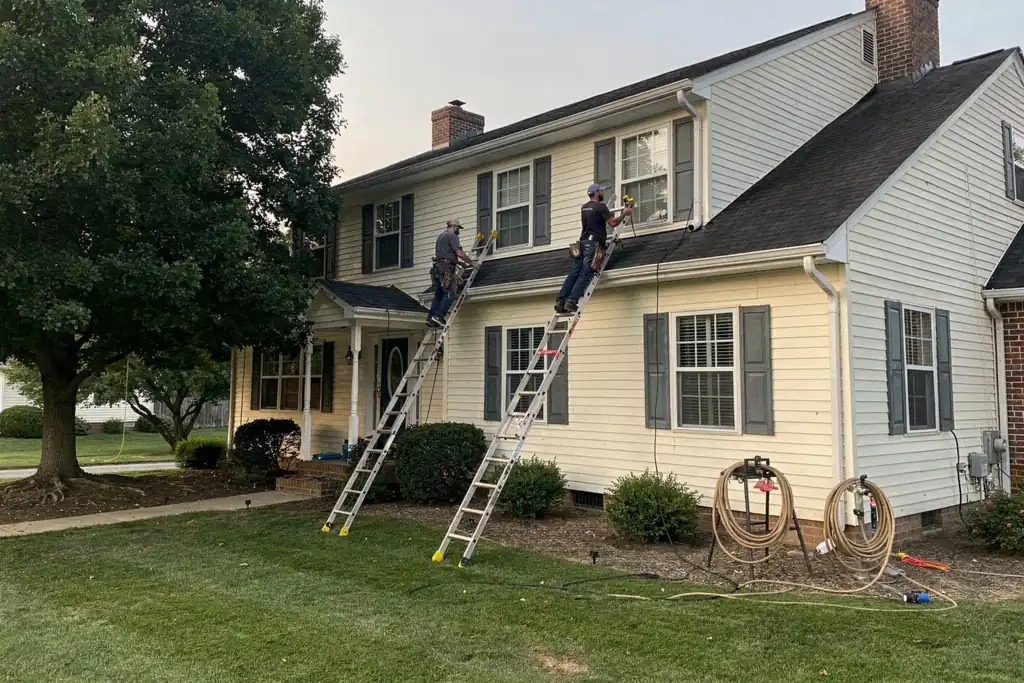
We quote commercial jobs per building, priced from the footprint and height of each structure, with fall protection or a boom or scissor lift on every job and a photo report once we finish. Our crew is ours and scheduled, not a roofer's side job between re-roofs. We have been servicing commercial properties across Virginia for spring and late fall visits, and we do the work on a calendar that property managers can plan around.
Quoted per building from footage, height and gutter type, in writing, before anyone is dispatched. Scheduled service costs less than a call-out.
We quote every job per building from linear footage, height and gutter type, in writing, from a site plan or a satellite measurement before anyone is dispatched. Send the address and we will return the figure for each building on the site.
Building height moves the price more than anything else on this list. Past three stories, the crew works from a lift with its own safety setup, which changes crew size and time on site. A clog packed with compacted debris on a system that has not been cleaned in years takes longer than a routine clean. Gutter protection that must be lifted and reseated, oversized or box gutters, roof drains and scuppers on flat roofs, and the number of buildings on one site all move the quote. A blocked run that lets water overflow onto the siding below adds time to the walk-around, so we price for it. Downspout flushing and debris haul-off are included per building and are not billed as extras. A thorough cleaning reaches the back runs and the valleys, which is why a thorough gutter cleaning on a large building is quoted for the time it takes. A first visit carries the measuring and the walk-around, and a repeat visit to the same building does not, so standing schedules come in lower. Keeping the gutters clear is the simplest way to protect your home or business from water damage.
On a multi-building site, the quote turns on stories, roof type and the number of buildings, which is why we ask for the site plan first. Our cleaning services are quoted per building, with the footage and height for each one on the quote. For any Roanoke property, we need the address or site plan, the number of stories, the roof type, the number of buildings, and who the invoice goes to, and we will confirm the quote before we book the date. Call (866) 435-6328 or text a photo of the roofline and we will start the estimate.
| Per building | |
|---|---|
| Standard, one to two stories | from $150 |
| Oversized box or industrial gutters | from $295 |
| Three stories and up, with a lift | from $395 |
Your lease decides, not state law. Here is how the three common cases usually read.
On a commercial lease, responsibility for gutter and downspout cleaning is set by the lease itself, not by the habitability rules that apply to apartments.
Triple net (NNN). The tenant usually carries building maintenance and exterior upkeep, in full or as a pro-rata share, and that normally includes gutters and downspouts.
Gross lease. The landlord usually keeps the roof system and exterior upkeep, gutters included, inside the base rent.
Lease silent. When the lease says nothing, the obligation generally falls to the landlord, because gutters are treated as part of the building's roof and structure.
Whoever the lease names, tell us and the invoice goes to that party, so the property manager is not stuck in the middle.
This is general information, not legal advice. Read the maintenance clause of your lease or ask the attorney who drafted it.
At least twice a year for a standard building. Restaurants, flat roofs and anything under trees, quarterly.
Across Virginia, most commercial properties we service are on twice a year, in spring and late fall, while restaurants, flat roofs with internal drains and buildings under heavy tree cover are on quarterly. Across Virginia, the spring visit lands in mid to late May, after the snow months of December through March, and the fall visit runs November to early December, ahead of the first hard freeze. Roanoke gets about 42.8 inches of precipitation a year, and May, June and July are the wettest months, so a clear system matters most as the rain picks up. Across Virginia, storm season brings hurricanes and tropical remnants, and the managers who call us after a storm usually find debris in the downspouts and on flat roofs.
On a flat roof, parapets, internal drains and scuppers back up silently. The first thing a tenant notices is a stained ceiling tile or a membrane blister, which is how a slow leak usually shows up, and that is why the monthly check between cleanings exists on those buildings. A restaurant gutter is cleaned on a shorter cycle because grease and debris build up faster than on a standard office roof, and the cleaning solutions for grease are not the ones for leaves. The cleaning process on these properties is matched to what we pull out of them, not to a fixed rule.
If you are not sure which schedule fits your property, send us a photo of the roofline and a note on the property type. We will tell you what we would clean and how often. Our schedule works the same way for residential and commercial buildings. Where a gutter guard is in place, we lift it to clear the runs, and regular gutter maintenance keeps each visit short. A building set in a mature landscape drops more leaves into the runs, so we check its schedule first. The gutter system on each building determines the cycle, and we would rather match it to the building than send every site the same invoice.
| Property type | Baseline | Why |
|---|---|---|
| Standard office, retail, multifamily | Twice a year, spring and late fall | Seasonal debris before heavy rain and freeze |
| Restaurant and food service | Every two months | Grease and exhaust residue speed up clogs |
| Industrial and manufacturing | Quarterly to semi-annual | Airborne dust and soot |
| Heavy tree cover over the roof | Three to four times a year | Leaf and needle load |
| Flat roof with parapets and internal drains | Quarterly, monthly checks | Drains back up silently; membrane damage |
Tied off or working from a lift, never free-standing on a ladder against a parapet.
Federal OSHA requires fall protection for construction-type work at six feet and above (29 CFR 1926.501) and for general industry at four feet (29 CFR 1910.28). Commercial gutter lines sit well above both. Our crew works tied off or from an aerial lift, never free-standing on a ladder against a parapet. Above three stories the job is done from a boom or scissor lift, which is why height is the biggest single factor in a commercial quote. The lift is matched to the building: we bring whatever boom or scissor lift the roofline needs. Where a state runs its own OSHA plan with stricter triggers, the crew follows the stricter rule.
Gutters, downspouts, drains and scuppers, hauled debris, and a photo report per building. Nothing on this list is an extra.
Per building. Every gutter run cleared by hand or vacuum, not just the sections visible from the parking lot. Every downspout flushed until it runs clear; a blocked downspout cleared from above where reachable. Below-grade drain lines are cleared on request and quoted separately. Roof drains and scuppers on flat roofs cleared of debris and the strainer domes reseated. Debris bagged and removed from site, including from parking areas and walkways under the work. Downspout outlets and splash blocks checked.
Report. Before-and-after photos of each run and each drain, per building, with anything found (a pulled hanger, a separated seam, standing water that points to slope, a cracked scupper) noted and photographed, not repaired without authorization. Invoice per building with the linear footage shown, so a board or an owner can check it.
Not included. Gutter repair or replacement, guard installation, roof repair, pressure washing of the building. Where a problem is found, you get the photo and a plain description; what to do about it is your call.
The same crew on a fixed calendar, a lower per-visit rate, and a storm call-out when you need one.
A one-off cleaning is priced as a one-off: dispatch, setup, lift if needed. Put the property on a schedule and the plan is priced for that building, because the crew knows it, the footage is already measured and the dates are booked a season ahead. Semi-annual (spring and late fall) suits most standard buildings; quarterly suits restaurants, flat roofs with internal drains and anything under heavy trees. Plans and their pricing are set building by building: call or email us to set one up.
A scheduled property also gets one contact for every building in the portfolio, across city lines where we cover the neighboring towns.
One contact for every building, a date in writing, and the crew checks in with your on-site person before a lift goes up.
Our professional gutter cleaning services cover the business districts, corridors and business parks of Roanoke where we have serviced buildings before. Roanoke is the center of our service area, and we provide gutter cleaning for commercial properties in the surrounding areas too. For a multi-building portfolio, we handle the whole site with one contact, a date confirmed in writing, and our crew checks in with the on-site contact on arrival. Where tenants or access rules require it, we time the work around tenant hours, so the parking lot and walkways stay open while we work.
Gutter cleaning and maintenance for commercial buildings is the core of this work, and we offer gutter cleaning on a one-off or scheduled basis depending on what the building needs. Water damage is the reason most managers call us, usually after a blockage has pushed water behind a fascia or down a wall. We are a gutter company with commercial crews, and we serve homeowners and businesses alike: a homeowner with one house gets the same written quote a property manager gets for a portfolio. Whether it is a home or business, tell us the cleaning needs for each building and we will return a written plan.
We price per building, and the figure depends on linear footage, height and gutter type. Many gutter companies and gutter cleaners quote by the foot, but each building here gets its own written quote before we book, so you know the number for every structure on the site.
The lease sets that split, and the invoice goes to whichever party it names. For the legal reading of the clause, your lease counsel is the right source, not us.
On the restaurants and flat roofs we service, quarterly is the schedule that keeps the drains and scuppers clear. The monthly check between cleanings catches the backups before a tenant sees a stain on the ceiling.
Yes. We work from a boom or scissor lift with fall-protection gear for anything above three stories, and we confirm the setup against the building before the date is booked.
Yes. We schedule around tenant hours and site access rules when you tell us what they are, and our crew checks in with the on-site contact when they arrive.
We clear roof drains and scuppers on flat roofs along with the gutters, and we photograph the drains before and after so the report shows what was cleared. We finish with a final inspection of each drain before the report goes out.
After a storm, the post-storm call-outs usually turn up debris packed into downspouts and on flat roofs. A clogged gutter that goes unnoticed can cause roof leaks, so we inspect the runs, clear what is blocked and photograph the results for the report.
Yes. We invoice each building separately and set up a recurring schedule across the properties, with one contact for all of them. This works for commercial buildings and residential gutter systems alike. Call (866) 435-6328 and we will set up the schedule with you.
Footage, height and the address by phone or email. The quote comes in writing, per building.