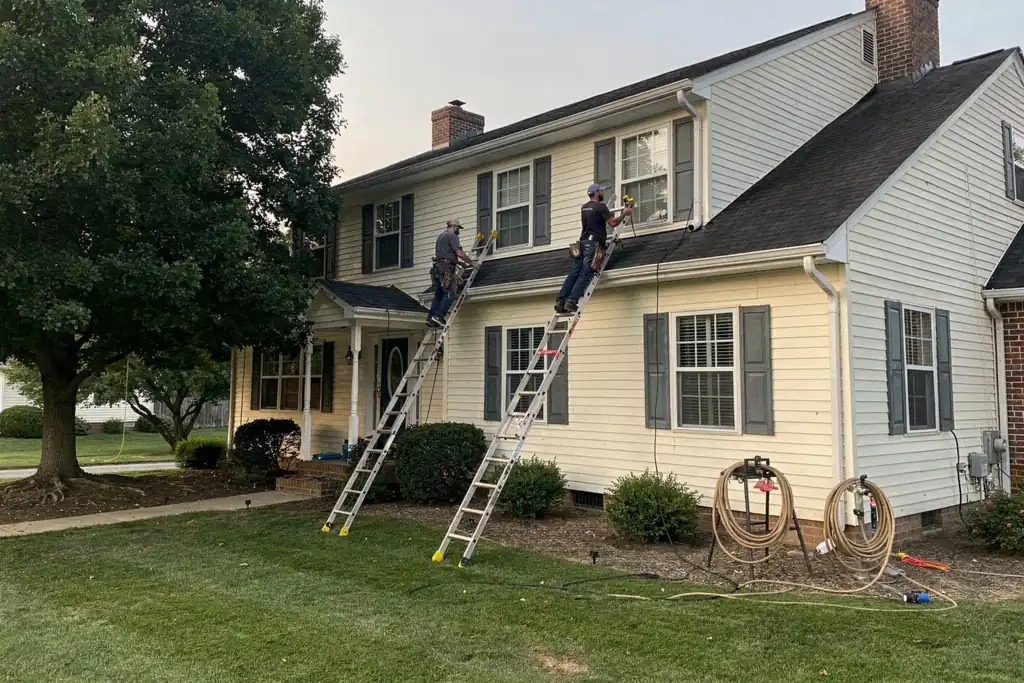
Our own crews clean gutters across Vermont, with every downspout flushed and flow-tested, debris hauled off, and photos sent before we leave. The number you get on the phone is the number on the invoice. Vermont's calendar is shaped by freeze-up, so the fall cleaning before the ground hardens is the one most people book first. Pick your city in the index below for the local page, and call (866) 435-6328 to get on the schedule.
Across Vermont the price depends on the number of stories, the size of the house and what is sitting in the gutters, and we quote it by phone or text from those three things. The number we quote is the number we charge. Some companies price by the linear foot instead, which is the other common model, and we will walk you through either one on the call.
What moves the quote on our jobs across the state is what the crew runs into once the ladder is up. A third story or a steep roof takes longer to work safely. Gutters left for years come down heavier, with compacted debris that has to be chipped out rather than scooped. Guards have to be lifted and reseated before anything underneath can be cleared. Where a house sits under heavy canopy or in the snowbelt, the debris load and the freeze-up risk change how much time the job takes.
The exact range for a house is on its city page. Downspout flushing, flow testing and haul-off are included everywhere in Vermont, so nothing is added at the end. Call (866) 435-6328 or text us your address and stories, and we will give you the number before anyone climbs.
The usual Vermont schedule is two visits a year: a late-spring visit in mid to late June, and a late-fall visit in October to early November, depending on the region. Those visits catch the seed and pollen drop and the wet leaf mat that follows the leaves coming down.
Where the first frost comes in October, which is most of the state, the fall visit matters most. Houses that skip it can carry ice at the eave through winter, because trapped water freezes before it can drain, and runs that have sagged under the weight are common.
Where the first frost comes in late October, the timing is tighter but the reason is the same: trapped water freezes before it can drain. Where the first frost comes in late September to October, the late-fall window is shorter, so we start scheduling earlier.
Across all regions the leaf drop comes first, then the wet mat, then freeze-up, and the fall visit sits between the leaf drop and the first hard freeze. Under heavy tree cover, plan on more frequent visits than the two-a-year schedule, because needles and grit pack the downspouts between visits. With few trees, one visit in late fall is often enough. Find your city below for the local page, and call (866) 435-6328 to book your visit.
We do not give a figure on this page because the price depends on the house. Call (866) 435-6328 or text us the stories and size, and we quote it from those. The city pages show the range for your area.
The usual Vermont schedule is a late-spring visit in mid to late June and a late-fall visit in October to early November. Where the first frost comes in late September, the fall window is earlier. Which one applies to your lot depends on your region and your trees.
The city index on this page lists every Vermont city we work in. Towns between the listed cities are covered from the nearest one, so check the index and call if you are not sure.
Usually not. Insurers treat a clogged gutter as skipped maintenance, and a standard policy excludes damage that comes from it. This is not insurance advice, so check your policy or ask your agent.
Yes. Most of the state gets its fall visit in October to early November, part of the state in late October to November, and part in late September to October, because the first frost arrives at different times across the state.
No. If the crew finds something that changes the job, such as a loose hanger or a gutter that cannot be cleared the way you expected, you hear it and agree to it before any work starts.
Call (866) 435-6328 or text a photo of the house front. The number we give is the number on the invoice.
We also serve these communities across the state