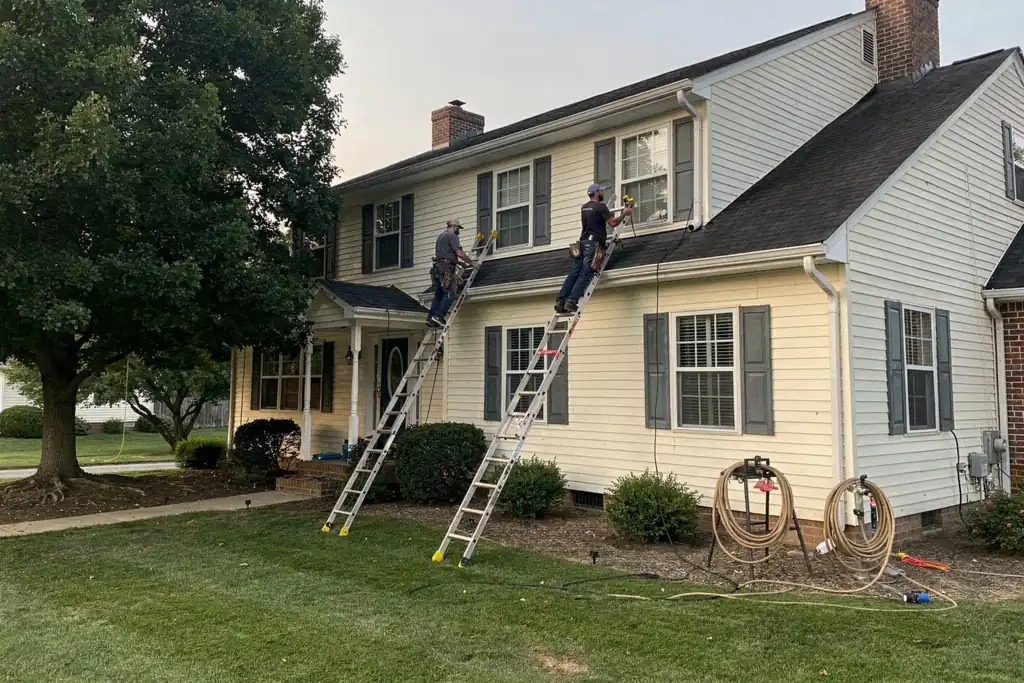
Yes, the same two people clean your gutters and the outside of your windows in one visit, gutters first and glass last. We price it by the number of stories and the approximate window count, and both jobs done together cost less than booking them as two separate trips. Across Oregon, most of our customers book spring and fall, and that is the calendar we run around.
Priced by stories, not by a visit. The bundle costs less than two trips, and the number on the phone is the number on the invoice.
Window washing and gutter work get priced together by stories and approximate window count, and the bundle in one visit costs less than booking the two jobs separately. Our washing services are quoted by phone, and the number we give you is the number on the invoice. Call (866) 435-6328 or text a photo of the front of the house, and we will work it out from there.
On the day, the crew finds what drives the quote. A third story or a roof too steep to walk takes more time on the ladder and more setup. Window count matters, and so do picture windows, which are slower to dry without streaks. Clogged gutters that have not been opened in years and are packed with needles and leaves take longer to clear, and gutter guards have to be lifted and reseated before anything underneath can be reached. Hard-water spotting from sprinkler lines is a separate issue, because no set of cleaning solutions removes it. Heavy grime on the frames means the crew has to remove dirt before the glass comes clean, and we price that in. Downspout flushing, screen rinsing and sill wiping are part of the job, not extras we bill later.
On our Happy Valley jobs, the quote usually moves most with stories and what the gutters look like after a season. One house on a sloped lot had three stories on the downhill side and a long window run under a line of tall trees. The crew cleared the gutters, flushed each downspout until it ran clear, and then did the glass. The quote was set from the stories and the window count the owner sent by text, and that number held on the invoice. Ask us for the same thing when you book window cleaning services: stories, window count, and a photo of the front of the house, and you get the number you can plan around.
Gutters and downspouts get the first pass, because runoff from them is what ends up on the glass below. The crew clears the packed debris, checks for standing water in the troughs, and only then starts on the windows. Some jobs need a second look at the drain, and we tell you before we charge for any of it. The goal is that nothing left in the gutters runs down the siding or onto the clean panes. The crew checks every window for runoff marks before it packs up. Condos with several floors of glass and balconies need the same order of work, just more ladder time.
| Gutters only | Exterior windows only | Both in one visit | |
|---|---|---|---|
| One story | from $150 | from $150 | from $240 |
| Two stories | from $195 | from $210 | from $325 |
| Three stories | from $255 | from $285 | from $430 |
For context, nationally. Angi puts the average US gutter cleaning at $168, most homeowners paying $119 to $234 (Angi, 2026). Exterior-only window cleaning runs roughly $4 to $10 per window, or $100 to $250 for a typical home, with $3 to $5 per window more on upper stories (Angi, HomeGuide, via Google AI Overview, Oct 2026). Priced by stories, the most common model, a two-story gutter cleaning sits around $150 to $300 nationally. If a quote you are holding sits far outside these, ask what is driving it.
On every house we work, the first scoop out of a gutter ends up on the wall below it. We put the glass last so it ends up there once.
Gutters first, glass last. That is the order on every job our crew does, and it is the reason we book both with one crew instead of sending two.
What we see from the ladder. When we clear a run, the leaves, the grit and the black water that sits under them come down the wall and across any window below it. Flushing a downspout throws more of it, in a stream, onto the panes beside the outlet. If the glass was washed first, someone has to wash them again before we are off the ladder. So we do the roof blow-off, clear the gutters, flush every downspout, give the wall a few minutes to stop dripping, and only then start on the glass. The panes under the downspout outlets are the last ones we touch on the house.
Two things we do differently from a window-only crew. We rinse the siding under each run before we move to the glass, so nothing left on the wall washes down onto it in the first rain. And we do the top-floor glass from the same ladder position as the gutter run, one setup per side of the house, which is where the bundle saving comes from: no second trip, no second setup.
Downspouts flushed, screens rinsed, sills wiped, bags hauled. None of it shows up as a line item.
Gutters. Roof blow-off where debris sits above the gutter line. Every run hand-cleared, not just the visible stretch from the ground. Every downspout flushed with water until it runs clear, and a blocked one cleared on the spot where it can be reached from above. A downspout that feeds a buried drain line is checked at the outlet; clearing the buried line is a separate job, quoted before anyone touches it. Debris bagged and taken away. Before-and-after photos of each run, sent to you before the crew leaves.
Windows, exterior only. Every reachable pane on the outside of the house, cleaned with a water-fed pole and purified water so the glass dries without streaks or towel lint. Frames wiped. Screens taken down, hand-rinsed and put back on request. Sills wiped. Upper-story windows done from the pole, not from a ladder leaned on the siding.
Not included, and we say so up front. Interior glass. Hard-water or sprinkler staining etched into the glass, which needs a separate mineral treatment and is quoted after the crew sees it. Post-construction paint, stickers or stucco. Skylights and solar panels. Pressure washing of siding, decks or driveways. Gutter guards: if a run is covered, lifting and reseating the guard adds time and is quoted by the foot before the visit, never on the day.
Twice a year for both, and the same two months, which is why one visit covers it.
Most of our Happy Valley customers book regular cleanings twice a year, once in the spring and once in the fall, which is why one crew in one visit makes sense for them. Across Oregon, the spring visit usually lands in mid to late June, after the pollen season has settled, and the fall visit runs late November to December, after the leaves have come down.
Pollen is the first thing we notice in the spring. Yellow film settles on south-facing glass and a paste of pollen and seed sits in the downspout elbows. On a window with no trees nearby, a light film is easy to miss. Once it dries it sticks, and it shows most in low sun. The leaf load comes in the fall, and it packs the gutters into a wet mat that holds water against the fascia. Happy Valley's wettest months are November, December and January, so a packed gutter has the most water to hold right when the leaves are down, and freezing is a real risk here once the cold sets in.
Some homes need a third of these cleanings, and we say so on the first call. Heavy tree cover over the roof means needles, seeds and grit pack the gutters between visits, so those houses run on a shorter cycle. A sprinkler line that hits the glass leaves round white spots that come back a day after cleaning, which is mineral, not dirt, and it needs its own treatment. A house near a busy road or a construction site collects more grime on the outside of the glass, and it shows faster.
Two customers on the same street show the range. One has no trees over the roof and books once in each season, and the windows and gutters have stayed clean between visits. The other has tall trees and a sprinkler line on the south side, and books three or four times a year. Our crew found the spots on the second house came back within a day until the sprinkler was adjusted, so the frequency went up while that was being fixed.
Clean windows and dirty ones look the same at noon, so judge them in low sun. When a haze shows then, and you can see it on the glass from inside, it is time to book. You will know the gutters need it when water sheets over the edge in the rain instead of running down the downspouts.
Most two-story homes are done in a morning. You do not need to be there, and you get the photos either way.
The crew calls the day before with a two-hour arrival window, and again when they are on the way.
How long. This Old House puts a professional gutter cleaning at 30 minutes to an hour on a typical house. Exterior windows on the same house run about the same again or a little more, so plan on a morning for a two-story home and most of a day for three stories or a house with a lot of glass. Gutters that have not been touched in years, steep roofs and wraparound porches run longer.
Before the crew arrives. Turn the sprinklers off the night before, so the glass is dry and the ground is not mud. Move cars off the driveway if windows face it. Keep pets inside while ladders are up. Unlock side gates. Nothing else; the crew brings its own water and power.
While they work. Gutters first, glass last, as described above. Nobody needs to be home for exterior work; the crew does not come inside. If something cannot be reached safely (a pane over a sunroom roof, a gutter run behind a tree limb) the crew photographs it and tells you rather than guessing.
After. Photos of every gutter run and the finished glass, sent by text or email before the crew leaves. The invoice matches the number quoted on the phone.
Send a photo and we tell you what it is. No argument about whether it rained.
Streaks. Purified water dries clean; a streak means something was missed, and that is on us. Send us a photo of it and we tell you what it is.
Spots that come back. Round white spots that return a day after cleaning are mineral deposits from sprinklers or hard water etched into the glass, not dirt. Cleaning cannot remove them; a mineral treatment can. The crew flags it on the visit so you are not surprised.
Rain the next day. Rain is distilled water and does not dirty clean glass by itself; what spots glass after rain is dust already on the frame or screen washing down. That is why frames and screens are done, not just the pane. If it looks worse after a storm, send the photo and we look at it.
Overflow after a cleaning. If a gutter runs clean and still sheets water over the edge in the next rain, the cause is slope, a sagging hanger or an undersized downspout, not debris. The crew notes what it saw and tells you; cleaning it again will not fix it, and we will not sell you a second cleaning for a slope problem.
Your house. Ladder stand-offs on every ladder so nothing rests on the gutter lip or dents the siding. Screens go back in the window they came out of.
Neighborhood by neighborhood, with a lead time we say out loud, and a call before the truck turns in.
We run our crew around Happy Valley and the surrounding area, and the calendar fills fastest during the two busy windows of the year, spring and fall. Booking starts with a call or a text. To schedule service, give us the number of stories and send a photo of the house front, and we give you a quote and a date. Lead time depends on the season, and we tell you the next opening when you call. We call before we come, so you are not left guessing about the arrival window.
Our window cleaning services cover residential properties, and our window cleaners handle residential and commercial jobs, including multi-story buildings where the job calls for it. Professional window cleaning is a matter of getting the order right: gutters first, then the glass, so the runoff never reaches clean panes. That order protects the curb appeal of the house, and it keeps water damage from starting behind a sagging run of gutter. When clogged gutters back up, the water finds the nearest weak spot, and that spot is usually the fascia.
Nobody needs to be home for the exterior work. Our crew stays outside, does not clean windows inside, and sends photos of every run, every downspout and every window before the truck leaves. Leave the side gate unlocked and keep pets inside while the ladders are up. If you want to be on site, that is fine too, but it is not required.
Yes. The same two people do both on one visit, gutters first, glass last, so nothing from the gutters runs onto clean windows.
The number for residential properties comes from stories and window count, and we give it by phone or text. Call (866) 435-6328 or text a photo of the front of the house.
On most of our Happy Valley jobs, yes. Pollen, rain dust and sprinkler spots all collect on the outside, and they dull the glass even when the inside is clean. Standard cleaning solutions handle the film, but mineral spots need a separate treatment.
Most of our customers here book spring and fall. Across Oregon, the spring visit runs mid to late June and the fall visit runs late November to December, so most people schedule service around those windows.
Not when we do the job. Gutters first, glass last, so the runoff is cleared before anyone touches a pane.
Screens are rinsed, every window gets its sill wiped, and tracks are part of the glass work on this visit, so none of it is a separate line item.
Exterior only on this visit. Interior and exterior glass are never billed as one job, and pressure washing is not part of this visit.
No, you do not need to be home. Turn sprinklers off the night before, move cars off the driveway, and keep pets inside while the ladders are up.
Stories, rough window count, a photo of the front by text. That is a real number, not an appointment.