East Rochester, New York homes sit on compact village lots where historic housing structures stand close together. Keeping rainwater flowing away from these established properties requires clear drainage lines season after season. We provide complete gutter cleaning to clear heavy organic debris, safeguard structural foundations, and keep water moving off every roof line. Our local crews work directly on residential properties throughout the area to deliver dependable gutter cleaning service that protects your property from unwanted overflow.
The housing stock here features classic architectural styles that require steady maintenance. According to the American Community Survey (2020-2024 estimates), detached single-family houses make up about 54% of local residences. Older construction dominates the streetscapes, with about 97% of homes built before 1990 and roughly 49% constructed before 1940. About 39% of occupied homes are rented. These mature structures often feature steep roof pitches, traditional wooden fascia, and original trim details. When debris blocks gutters on these classic buildings, backed-up water can quickly migrate under aged shingles, soak into wood framing, and cause costly moisture damage inside exterior walls.
Local weather patterns bring heavy demands on every residential gutter system. Broadleaf red maple, white oak, hickory, tulip poplar, and sweetgum trees are common in the region, along with eastern white pine conifers. In spring, oak catkins drop directly onto roof slopes, while acorns and spiky sweetgum balls collect in late summer. Fall leaf drop usually peaks in early October, filling channels with thick debris. As winter approaches, freezing nights arrive, bringing snow and ice dams in gutters that trap standing water. If a clog prevents drainage before cold weather sets in, trapped ice expands inside the channel, warping metal and pulling gutters away from the roofline.
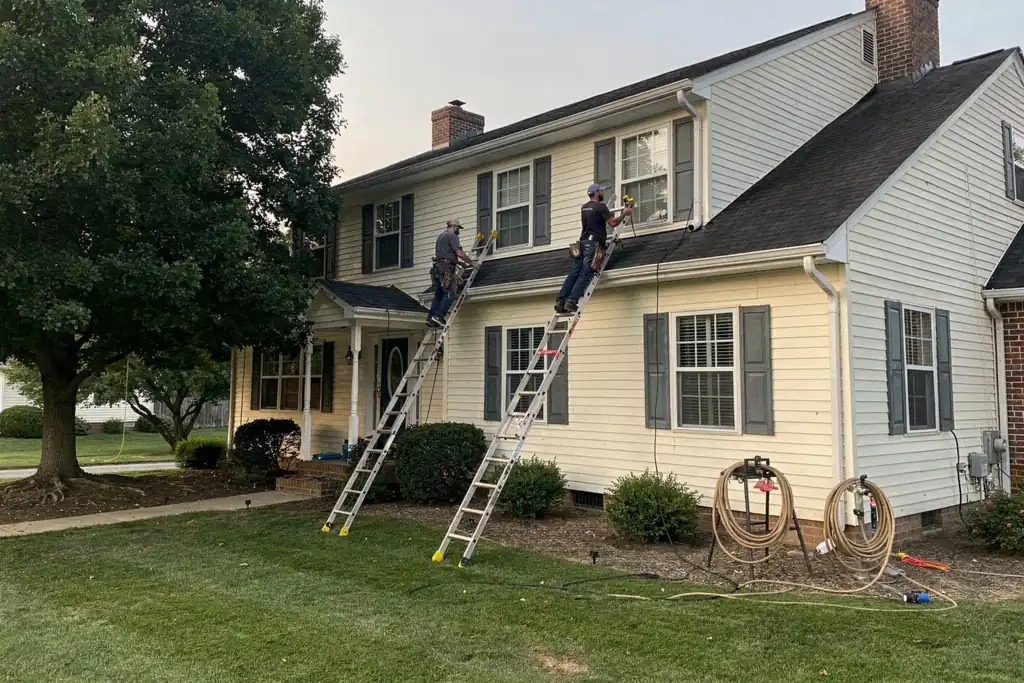
Our crew clears your entire drainage system safely from ladders without walking on fragile roof surfaces or damaging your trim. Every job follows a systematic process to remove buildup, restore full water flow, and verify that your system is fully clear.
We offer three flexible plans designed for local property needs. A single visit plan fits a home with minimal tree cover that only needs occasional maintenance. The twice a year standard plan includes spring and fall visits to clear seasonal catkins and fall leaves, making it ideal for most local properties. A quarterly plan provides four scheduled visits a year for a property under heavy foliage that drops leaves and pine needles continuously, preventing severe clog issues before they start.
The process begins when a homeowner calls or submits our online form for a free estimate. We inspect the property to evaluate total gutter footage, structure height, foliage levels, and ladder access. Our crew clears all channels by hand, placing bagged debris onto ground tarps. We never use high-pressure washers that strip fascia paint or roof blowers that scatter mess. Every downspout is flushed with water to confirm open flow. Afterwards, we walk the site with you before taking payment.
Visible warning signs show when it is time for service. You might spot active water overflow during heavy rain, or notice small plants growing directly in the gutter channel. Debris accumulation creates extreme weight, causing sagging along the fascia line. Down on the ground, water pooling near the foundation or washouts along garden beds indicate that choked channels are failing to push runoff through the downspouts.
Delaying regular maintenance creates serious long-term structural risks for your house. Trapped water causes internal water damage, leading to basement flooding and severe foundation cracks over time. Saturated organic debris resting against wood trim causes structural fascia rot and attracts destructive pests. Neglected gutter channels also increase winter ice accumulation, which pulls heavy hardware away from siding and damages exterior walls during freeze-and-thaw cycles.
Final pricing depends entirely on the physical characteristics of your property and the current condition of your system. Total square footage, house height, and total linear gutter length influence the amount of labor required. Properties with severe blockage, heavy shingle grit, or difficult ladder positioning take longer to clean thoroughly. Standard service plan selection also affects individual visit rates, offering predictable costs for ongoing seasonal maintenance.
We serve residential properties across Monroe County, including nearby communities like Fairport, Pittsford, Penfield, Perinton, Brighton, Rochester, Irondequoit, and Webster. Our service area also extends to properties near St. John Fisher College, Nazareth College, Gananda, and Rochester Institute of Technology.
Fall leaf drop usually peaks in early October here. Clearing accumulated leaves prevents frozen clogs during cold winter nights when ice dams in gutters can cause backed-up water to seep under shingle edges.
Most properties benefit from our twice-a-year plan covering spring and fall. However, properties situated under dense regional trees like white oak or eastern white pine often require quarterly service to keep channels running clear.
No, we clean channels entirely by hand and scoop debris directly into bags. Power washers can strip paint from your fascia, while leaf blowers on roofs scatter debris into your landscaping and yard.
Our technicians flush every downspout with water to test drainage flow. If a downspout remains blocked, we snake the pipe until water flows freely out the bottom extension away from your home.
Protect your home from hidden water damage today. Call TrueEdge Gutter & Fascia at (866) 435-6328 or fill out our simple online form to receive your free written flat-rate estimate.
Get a free estimate